
2026 Complete Guide to Social Media Automation: From Manual Posting to Multi-Platform Intelligent Distribution
The same product tweet needs a square image on Instagram, a compressed version under 280 characters on X, a formal tone on LinkedIn, then you have to log into each platform, paste, check for typos, and confirm the publishing time. A whole morning is spent switching tabs. Anyone who has done cross‑border operations knows this feeling: less than a third of the time is spent on the content itself, the rest is swallowed by format adaptation and account switching.
In 2026, social media automation is no longer a matter of efficiency tools; it is a basic prerequisite for multi‑platform operation. This article does not sell any tool; it dissects the truly worthwhile steps in an automation workflow, common failure modes, and hidden costs that only become apparent after a period of use.
Why 2026 Social Media Operations Can’t Do Without Automation
The number of platforms keeps expanding. Instagram, X, LinkedIn, TikTok, Threads, Pinterest, YouTube, Bluesky, plus Google Business—brands already exceed the reasonable limit for manual maintenance. Audience fragmentation means the same batch of content must appear on different platforms in different forms, and the volume of content production far exceeds what a single person can manually handle.
The hidden cost of manual cross‑platform posting is often underestimated. A common industry consensus is that operations teams waste an average of 10–15 hours per week on manual cross‑platform posting. This time does not become better content nor more precise targeting strategy; it is spent on copying, rewriting, pasting, and repeatedly checking. Even more troublesome is the error rate—posting to the wrong account, at the wrong time, or missing a tone adjustment are common accidents in multi‑account manual operations.
Brand consistency risk is more insidious than imagined. The same promotional message can be casual on X without issue, but a too‑light tone on LinkedIn appears unprofessional. When manually rewriting for each platform, consistency relies entirely on personal judgment; a change of personnel instantly shifts the style. Automation can at least lock the rewrite rules, giving the brand voice a reusable baseline. Cross‑border e‑commerce sellers feel this even more deeply; the issues mentioned in Cross‑Border E‑Commerce Sellers Using Social Automation Tools are almost identical to those faced by most multi‑platform operation teams.
The industry turning point actually happened a while ago. When content volume exceeds human capacity, automation is no longer a “whether to use” question but a “how deep to go” question.
Where the Real Barriers to Multi‑Platform Synchronous Publishing Lie
Content differences across platforms are the biggest cost source for automation. Instagram is visual, X is short‑form, LinkedIn demands professional depth, Threads favors conversational feel. Copy‑pasting the same copy without any adjustment usually performs poorly on all four platforms.
| Platform | Content Type | Typical Character Limit | Style Tendencies |
|---|---|---|---|
| Images, Reels, Carousels | 2,200 characters | Visual‑first, relaxed, conversational | |
| X | Short text, images, videos | 280 characters | Concise, direct, hashtag‑heavy |
| Long text, articles, documents | 3,000 characters | Professional, formal, industry insights | |
| Threads | Short text, conversation threads | 500 characters | Casual, interaction‑driven |
Publishing the same content on ten major platforms requires an average of 20–30 minutes of manual formatting and style adaptation. This figure balloons in collaborative settings—each person interprets “adaptation” differently, resulting in wildly varied styles.
Mismatched publishing times are another often‑overlooked issue. User activity peaks differ markedly across platforms; publishing at a single unified time inevitably misses the optimal exposure window for some platforms. Chaos from managing multiple accounts is also real: passwords scattered across people, who posted what and when, all relying on memory and chat logs.
Official API integration is the stability watershed. Using third‑party unofficial channels limits functionality at best and triggers platform risk controls at worst. Official API publishing channels typically maintain 99.99% uptime, provided the integration method is compliant and token management is proper. For specific publishing rules for enterprise accounts, see the X Enterprise Account Official Publishing Guidelines. Once this layer is solid, automation has a durable foundation.
Four Core Stages of an Automation Workflow: From Creation to Publication
A sustainable automation process usually consists of four stages: content generation, platform adaptation, scheduled publishing, and one‑click distribution with logging.
Content generation solves the “what to write” problem. AI drafts are valuable not because they are ready‑to‑use, but because they provide a modifiable starting point that eliminates the blank‑page time. Platform adaptation is the core value of automation—rewriting the same content according to each platform’s character limits, tone conventions, and audience expectations while keeping the core message unchanged.
Scheduled publishing solves the “when to post” problem. A content calendar acts as the hub, consolidating each platform’s schedule, publishing status, and history into a single view, preventing overlapping schedules across accounts. Unified multi‑account management is a prerequisite for scaling; otherwise, more accounts mean more chaos.
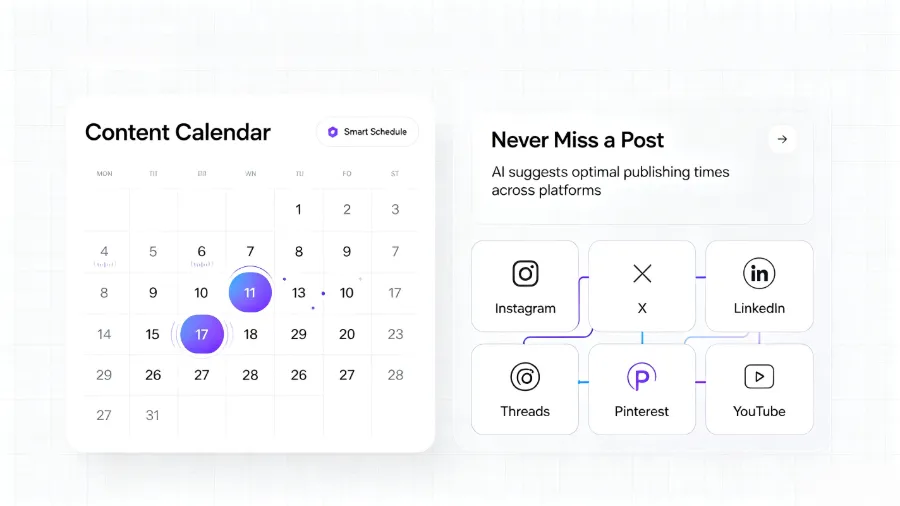
Within these four stages, the most common mistake in tool selection is “using a separate tool for each stage.” One tool for generation, another for scheduling, another for publishing—results in fragmented data, repeated account authorizations, and frequent workflow breakpoints. The key to linking stages is a single entry point that can handle the entire process. Tools like Flownib can connect accounts and start publishing in two minutes; their core value is compressing “creation—adaptation—scheduling—distribution—logging” into one interface, eliminating hand‑off costs. For the content format of new platforms like Threads, see the Threads Official Overview.
Once the workflow runs, the true determinant of automation sustainability is the content supply side.
Content Inspiration and Trend Capture: Keeping Automation Running
Even the best distribution automation stalls if creative ideas run dry. This is the most underestimated hidden bottleneck—no matter how full the schedule, without new content the calendar stays empty.
Trend capture solves this problem. By discovering hot discussions on Reddit, YouTube, news media, and Hacker News through keyword monitoring, you can turn emerging topics into publishable content, creating a “discover—generate—distribute” loop. The value of this stage is that content is no longer a brain‑dump; it is backed by hot‑trend data.

Real‑time hot‑topic scanning aggregates multiple platform sources; a single keyword can match several high‑interest angles. For example, entering “AI productivity tools” simultaneously shows Reddit practical discussions, YouTube tutorial trends, and news industry reports—each angle can become a standalone piece.
The link between trend capture and AI content generation is crucial for a closed loop. Captured hot topics feed directly into the generation stage; AI drafts based on trend heat, then proceeds to platform adaptation. In this process, a brand archive that constrains tone consistency is essential—without a unified brand profile, target audience, and product positioning, AI‑generated content will gradually drift from the brand direction. Multilingual teams have more complex needs on this chain; the Global Team Multilingual Content Automation Solution offers a reference implementation.
Automation on the distribution side quickly stalls without a content supply side. Many teams only realize this after a month or two.
Measuring, Scaling, and Common Pitfalls of Automated Operations
After automation goes live, tracking publishing records and platform performance data is the top priority. Publishing records answer “what was posted and where,” while performance data answers “which content works on which platforms.” Without these two data layers, automation is blind posting.
When multiple accounts and team members collaborate, permissions and process management become new bottlenecks. Who has publishing rights, who can edit schedules, who is responsible for review—if these rules aren’t defined upfront, collaboration costs can offset automation gains. As the business grows, moving from free plans to paid tiers is a natural path—free entry plans support 3 accounts and 6 posts, suitable for small teams to test the workflow before scaling.
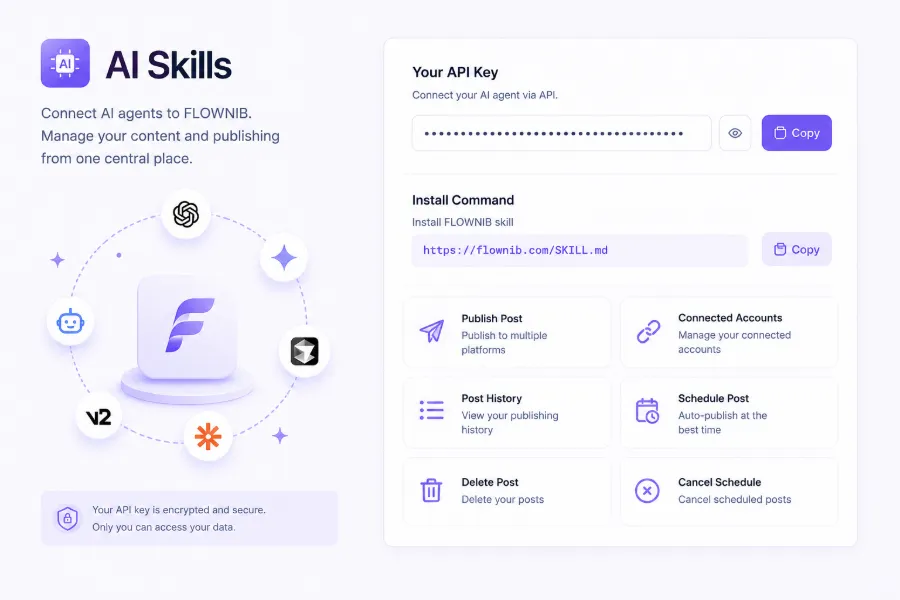
Automation does not mean “set and forget.” I’ve seen a team launch automation where the same promotional copy was AI‑adapted for each platform; the tone ended up too casual on LinkedIn and too formal on X, damaging the brand image. Adding a manual review node fixed it. This incident shows that AI adaptation needs human calibration, especially for brand‑tone content; the review step cannot be omitted. During the expansion phase, tools like Flownib also support Access Token integration with AI agents, handing publishing capabilities to higher‑level workflows, provided the review mechanism is already stable. A creator’s full “pitfall log” can be found in Creator’s Real‑World Test of Expanding Social Media Reach.
Common failure modes: (1) publishing incidents—expired tokens causing failures, schedule conflicts causing duplicate posts; (2) style drift—AI rewrites deviate from brand tone without detection; (3) content homogenization—identical posts across platforms cause audience fatigue. Avoidance is simple: keep a preview‑confirmation step before publishing, periodically audit actual platform outputs, and continuously feed new topics into the content supply side. Marketing teams can refer to Marketing Team Upgrade of Social Media Workflow Practices for process upgrade insights.
Automation’s benefits are real, but maintenance costs are equally real. It eliminates mechanical labor, not judgment.
FAQ
Will social media automation reduce the authenticity of content?
Yes, if no human calibration is applied. AI‑rewritten content usually maintains tone consistency but can feel “too smooth,” lacking the rough edges of human writing. The solution is to keep a lightweight review step, focusing on brand stance and sensitive topics; routine content can pass through.
Are automation tools suitable for individual creators or only for teams?
Both, but usage differs. Individual creators benefit by removing repetitive tasks, freeing time for content creation; teams benefit from unified processes and permission management. Individuals can start with free plans; teams should plan multi‑account permission rules from the outset.
Do we still need human review before each post?
Yes, but it can be tiered. Random checks for routine content, but every promotional, brand‑statement, or sensitive‑topic post must be reviewed individually. Automation removes mechanical work; judgment cannot be omitted. Early on, run full reviews; once stable, gradually relax.
Can a free plan meet a small team’s initial needs?
It can cover the workflow validation. Three accounts and six posts are enough to verify smooth workflow, AI tone alignment, and scheduling logic. After validation, upgrade to a paid tier for stability.
Is there a risk of accounts being throttled by platforms due to automated publishing?
Yes, primarily depending on whether the publishing channel is compliant. Official API publishing carries low risk; unofficial channels or frequent content changes may trigger platform risk controls. Excessive frequency or high content duplication also increase throttling probability, so pacing should be managed during scheduling.
Share Article