
Turning Real‑Time Conversations into the Next Blog Post

Cross‑border e‑commerce teams answer similar questions every day in support tickets, community groups, and comment sections: how long does shipping take, does a certain size fit, why did payment fail, where is the return address. After the issue is resolved, the chat logs are scattered across different systems, and by the time someone wants to write a blog, the original wording has been altered beyond recognition by the marketing department.
Real‑time conversations are not copy‑and‑paste material; they are signals that need to be filtered, verified, structured, and published before they can be observed. High heat does not necessarily mean high value; recurring specific obstacles are often more suitable for long‑term search content than a one‑off viral discussion. To turn a conversation into a blog, the team must first confirm who it represents, which market it occurs in, and what decision the article is intended to help the reader make.
Start by Finding Write‑able Questions from High‑Value Conversations
The first step in organizing conversations is not to open a writing tool, but to decide which conversations are worth keeping. Small talk in support tickets, simple thank‑you notes after a promotion, and one‑off order inquiries usually only indicate that a particular customer faced an issue at that moment and cannot directly reveal a content need suitable for public answering.

The team can first check four sources of: support records, community discussions, comment feedback, and public platform discussions. Public platforms include Reddit, YouTube comments, news discussions, and Hacker News. Each initial screening should cover these four sources; otherwise, it is easy to mistake an individual support agent’s judgment for a market‑wide demand.
High‑value signals usually manifest in several ways. A question that repeats across different support tickets, a user who raises a specific objection, persistent hesitation before purchase, or a follow‑up after using the product all suggest a clear purchase intent or usage obstacle. In contrast, a single user saying “feels good” has interaction value but is hard to support an article with informational gain.
When recording question frequency, do not look only at occurrence counts. Each conversation should also be tagged with market, language, product stage, and user role. For example, the same “why haven’t I received my goods yet” may concern a UK buyer about customs and local delivery, while a US buyer may be interested in carrier tracking; a brand‑new order and a two‑week‑old waiting order are not the same audience.
The original wording should be saved separately; the author’s explanation goes in another column. A customer says “I don’t want to pay shipping again for a return,” which should not be immediately rephrased as “consumers value flexible return policies.” The former preserves the real friction; the latter already injects the team’s marketing language. The most valuable content signals are often not high‑heat topics but specific obstacles repeatedly described in the user’s own words.
Turn a Real Question into a Clear Article Angle
Chat logs are not article structures. They usually contain jumping background, support supplements, user‑initiated question changes, and unanswered parts. Before entering the outline, each conversation must be distilled into four items: original question, specific scenario, blocking factor, and a verifiable answer direction.
For example, a German buyer asks: “If I pay with a local bank card, how long after a failed order will I see the refund?” This cannot be turned directly into “common issues with cross‑border payments.” A more accurate breakdown is:
- Original question: How long does a refund take after a payment failure?
- Specific scenario: German market, local bank card, cross‑border order
- Blocking factor: Lack of transparency in payment status and bank processing time
- Answer direction: Verify payment status, refund trigger conditions, and bank processing cycles
Next, determine what decision the article helps the reader make. Readers may need to decide whether to retry payment, how long to wait, or when to contact the merchant. Thus, the title could be “How long does a refund usually take after a cross‑border order payment fails?” The target audience is European buyers who have attempted payment but have not confirmed the order, and the article promises to explain the judgment steps rather than a generic overview of payment methods.
This step also prevents stuffing multiple markets, product issues, and roles into a single article. One core question can be expanded into 3–5 body sections and converge on one clear actionable conclusion. For instance, first confirm the charge status, then check the order page, and finally contact support based on the time window. If the article simultaneously discusses shipping, coupons, and account registration, the search intent will quickly become fragmented.
Different conversation signals suit different article angles, and the evidence requirements differ:
| Conversation signal | Suitable article angle | Required supplemental evidence | Writing to avoid |
|---|---|---|---|
| Repeated question | Problem explanation or how‑to guide | Support records, product policies, step results | Turning repeat count into market size |
| Purchase objection | Comparative analysis or decision article | Price, shipping, payment, return conditions | Exaggerating user fear |
| Usage failure | Error troubleshooting or case review | Logs, reproduction steps, version differences | Simply restating standard support answer |
| Comparative question | Selection guide or scenario comparison | Features, limitations, regional rules | Mixing different user roles |
In cross‑border operations, market and language are not decorative information. When logistics, payment, currency, or platform rules are involved, the author must add the corresponding context but cannot fabricate conclusions unsupported by the original conversation. If the team wants to keep turning scattered operational issues into topics, they can refer to the Cross‑Border Operations Automation Method, but automatic topic discovery does not equal automatic factual judgment.
Build a Verifiable Blog Draft from the Original Conversation
The draft can first follow the factual order of the conversation: an intro that explains the reader’s situation, background that clarifies why it happens, step‑by‑step answers, examples showing market differences, and a conclusion with an actionable judgment. Preserve the user’s language and question order before compressing; this is usually less distorting than applying a “problem—solution—call‑to‑action” template from the start.
When the draft enters a multi‑platform publishing workflow, the team encounters another type of friction. Some people on the day of publishing paste the chat logs directly into an article, saving a few hours of drafting, but the original text is not anonymized and the support answers have not been fact‑checked. After publishing, readers discover that the shipping time only applies to one country, and the comment section continues to ask about refund conditions; a week later the platform rules change, and the team must dig up the original order and conversation again, eventually taking down the old version and rolling back the page.
Therefore, similar responses from multiple people can be merged into a narrative, but personal names, order numbers, emails, addresses, and private communication content must be removed. Anonymization is more than replacing a name with “User A”; it also requires checking whether amounts, timestamps, product combinations, etc., could be used to infer a specific order. When dealing with Shopify orders, payment records, or support tickets, fact‑checking should retain the source rather than keeping only a seemingly complete conclusion.
Every major judgment must be linked to evidence sources such as product documentation, policy pages, data records, actual operation results, or market differences. Titles and sub‑headings should use expressions that readers truly ask, not internal feature names. After the draft is finished, it can be reviewed with three questions: Does it answer the original question? Does it add new, useful information for the reader? After reading, does the reader know the next step to take?
During the distribution stage, the content team also faces character limits, media formats, and review statuses on different platforms. For workflow friction involving account connections, rewrites, and publishing, see the Cross‑Border Social Media Distribution Tool Evaluation. However, platform adaptation should still be confirmed by editors line by line, rather than copying the original article title to all channels.
After the blog is published, content reuse can extend to community Q&A, sales follow‑ups, and short‑video scripts. When planning cross‑channel collaboration, the team can look at the Cross‑Border Content Collaboration Framework, especially the correspondence between original facts, derived expressions, and publishing times.
Split One Blog into Conversation Versions for Different Platforms
A core blog can first be broken into three content forms: a platform short post, a Q&A piece, and a short‑video script. The short post retains a single question, the Q&A adds judgment steps, and the video script opens with a concrete scenario. The three versions do not need to be published simultaneously, nor should they simply be truncated versions of the same paragraph.
The same “how to confirm refund after payment failure” article can emphasize easy‑to‑miss checks on Instagram, pose the question “charge succeeded but order not generated” on X, and be written as a case study of how cross‑border support reduces repetitive explanations on LinkedIn. Threads is suitable for keeping the follow‑up process, while TikTok needs to turn status judgment and timeline into a visual script. Audience, content length, and interaction style differ across platforms, so the entry point should differ as well.
In practice, publishing tools like Flownib reduce copy‑pasting and tab switching but also push the proofreading responsibility to the pre‑publish stage. The team must verify that AI rewrites have not altered refund conditions, currency units, or the original support intent, especially avoiding tool‑generated conflicts that never existed in the original conversation.
When publishing across languages, each term, tone, currency, time expression, and cultural background must be checked. “Business days” in English should not be mechanically translated to “natural days,” and the Japanese market may have different expectations for polite support language. The image below shows a workspace for adapting the same theme to different language markets; the workspace can help generate versions but cannot replace local editors’ verification.
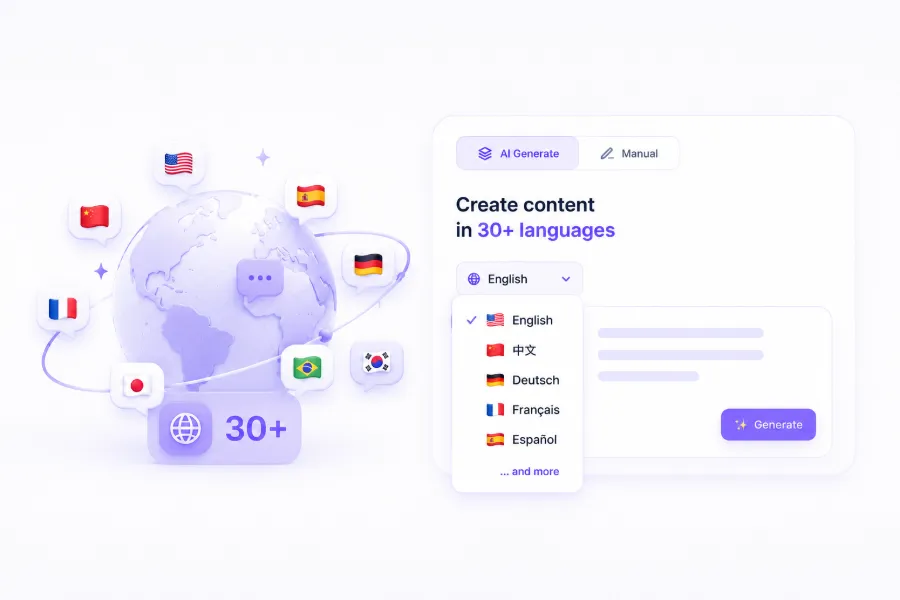
Flownib’s friction in cross‑platform rewriting, scheduling, and record‑keeping does not disappear entirely. Multiple account connection failures, a platform rejecting a specific media format, or a scheduled task hitting the wrong time‑zone can still force the team back to manual publishing. For TikTok video content, the team should check API permissions, video format, and platform limits before publishing; requirements can be directly compared to the TikTok Developer Documentation.
The team should also keep a record from the original blog to derived content, including publish time, platform, language, version, and interaction results. The purpose is not to fill a content calendar but to avoid a situation where a question is rewritten into ten versions and no one knows which version altered the facts. For an actual split method covering multiple platforms, see the Multi‑Platform Content Reuse Case.
If the team uses AI agents to connect to social‑media automation, they should also log the agent‑generated raw text, human edits, and final published version, facilitating troubleshooting of whether errors stem from prompts, rewriting, or platform interfaces. The related process can be further read in Connecting Agents and Social Media Automation. The value of publishing records typically becomes apparent only after a mis‑post or version dispute occurs.
Use Post‑Publish Feedback to Feed the Next Topic Cycle
After a blog goes live, comments, private messages, saves, clicks, and dwell time should be treated as feedback on the article’s angle, not just distribution metrics. High exposure but low clicks may indicate a mismatch between title promise and body content; many clicks but short dwell time may suggest the intro didn’t address the reader’s most urgent issue. Google Search Console query and impression data usually have latency, so a single refresh on the day of publishing should not be used to judge theme failure.
The team can observe two time points: the first 24 hours after initial feedback appears, and after 7 days of accumulated data. The first point is suitable for spotting obvious misunderstandings, broken links, and new issues raised in platform comments; the second point helps decide whether to rewrite the title, add cases, or expand into a separate topic. If only a step explanation is unclear, update the original text; if comments converge on a new user role or market restriction, start a new article; if the problem repeats but the answer is short, add an FAQ or example.
The content loop can remain “conversation → article → derived content → new question.” For example, a blog explains refund time, and a short‑video comment raises “card charged but order shows failure.” This is not just a simple engagement metric increase; it is a payment status issue not accurately named in the original conversation. A subsequent article can specifically explain pre‑authorization, charge, and order confirmation differences.
Maintenance costs must also be accounted for in the content lifecycle. When price, shipping policy, platform rules, or product processes change, old articles need re‑verification; version records help the team identify which paragraphs are affected without rereading the entire piece. Continuously listening to real conversations means accepting that some articles will be updated, some topics will be abandoned, and the next blog may not come from trending searches but from the third occurrence of a specific complaint today.
FAQ
How to determine whether a real‑time conversation is suitable for a blog article?
Suitable conversations usually repeat, contain concrete obstacles, purchase intent, or post‑usage follow‑up. The team should cross‑reference at least four sources—support tickets, community groups, comments, and public platforms—while considering market, language, and user role, to avoid mistaking a single order issue for a universal demand.
Can I directly turn a support chat log into blog content?
No. It must be anonymized, fact‑checked, and structured first. Names, order numbers, and identifiable details need removal; policies and timelines should be reconfirmed before publishing. Otherwise, an article may save drafting time on the day but cause more corrections and follow‑up questions later.
Should each conversation correspond to one article, or can multiple questions be merged?
Usually, start with one core question and expand into 3–5 body sections. Only when multiple questions share the same search intent, reader situation, and action decision should they be merged; otherwise, they should be split into independent articles to avoid titles and bodies answering different things.
How to use real conversations while protecting user privacy?
Delete names, contact info, order details, and any combination of data that could identify a user, while preserving the factual structure rather than the full original text. Have support or legal review before publishing, especially for content involving payments, addresses, or after‑sale disputes, and keep version records of the review process.
After a blog is published, how to tell if the conversation topic deserves further expansion?
First look at comments and private messages within 24 hours, then at accumulated click‑through rates, dwell time, saves, and repeat questions after 7 days. New follow‑ups that repeatedly point to an unnamed sub‑obstacle are suitable for a new article; if it’s just an unclear step, updating the original article is more appropriate.
Share Article


