
TikTok Shop Breaks the $100 Billion Barrier: Can Small Sellers Catch Up in 2026?
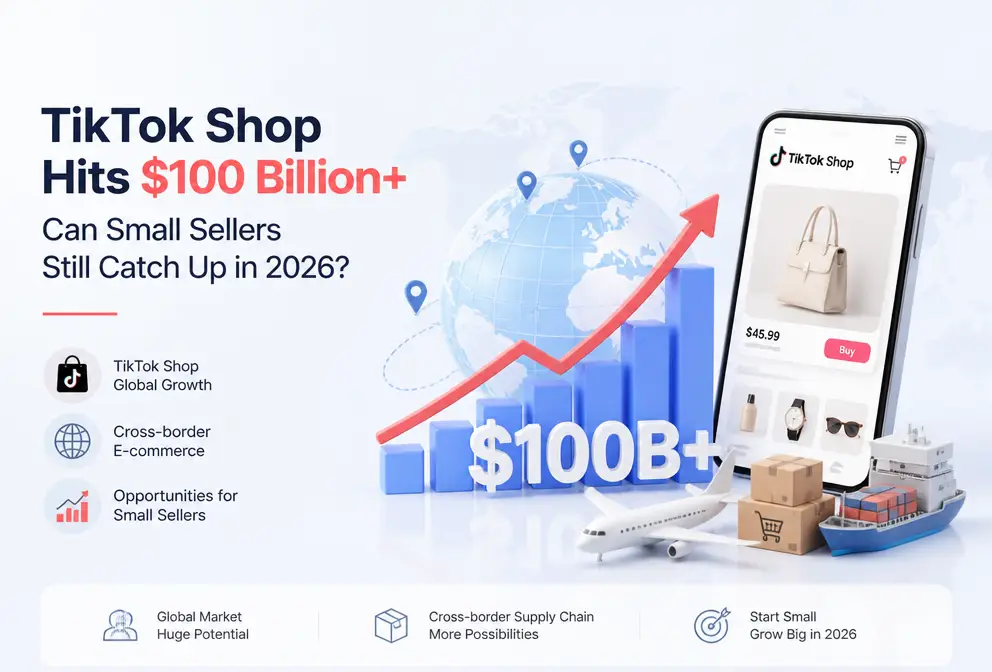
At the start of 2026, TikTok Shop crossed the $100 billion GMV threshold ahead of schedule, earlier than the market had expected. A more noticeable change is that the platform has begun issuing RFPs to brands, inviting institutional sellers to engage in resource matchmaking. A small seller who has been doing cross‑border e‑commerce for over two years talked to me about this, and his tone was full of hesitation: the scale is already huge, the rules have changed, and now entering the market may only leave the role of a “catch‑up” player.
I’ve seen this anxiety many times. With each platform cycle, a group of people are swept away by the “it’s too late” narrative and exit, while another group re‑enters with a different approach. The real question has never been whether to do TikTok Shop, but how to do it. The barrier to opening a store is actually lowering, while the barrier to content distribution is now the watershed.
Assessing the Profit Phase: Is There Still Room for Small Sellers in the $100 Billion GMV?
First, clarify two concepts: the platform’s profit phase and an individual seller’s profit phase are not the same. The platform crossing the $100 billion threshold indicates that the traffic pool is large enough and user shopping habits have formed, which is actually an infrastructure‑level advantage for newcomers. However, the platform entering the brand RFP stage means that resources are tilting toward institutional sellers, and the bargaining power of top influencers and brands is increasing.
The profit hasn’t been fully exhausted; what’s been consumed is the profit from indiscriminate stocking. Early tactics based on reselling, volume, and hitchhiking traffic have indeed run their course, but space for long‑tail products and niche content has opened up. To determine whether a market still has individual opportunities, look at three metrics: competition density, traffic cost, and content supply quality. In TikTok Shop 2026, competition density is rising, traffic cost is rising, but content supply quality is uneven—many small sellers are still propping up with low‑quality, repetitive material, which creates gaps.
As the platform scales, supply begins to stratify. The top tier is occupied by brands and agencies, the middle tier relies on vertical categories, and long‑tail players survive through differentiated content. The real window for small sellers is not the top‑influencer battlefield but the niche demands that big sellers overlook. This assessment is not just intuition; data comparing the efficiency of small sellers across social media channels shows a clear stratification trend.
The Real Entry Costs for Small Sellers: Money, Accounts, and Daily Operations
Most people calculate the cold‑start cost, only accounting for the deposit, advertising budget, and warehousing logistics—three tangible inputs. What truly drags small sellers down is the severely underestimated daily operational time cost.
Account qualifications and compliance requirements are hidden barriers. Each site’s entry conditions, category reviews, and tax registration require time to study. Opening a store may be done in a week, but getting the account system, payment channels, and logistics solutions all running smoothly typically takes a month.
The more hidden cost lies in the publishing stage. A small seller typically operates TikTok, Instagram, Facebook, and an independent site simultaneously; a new piece of content must be rewritten, adapted, and posted on each platform. Manual copy‑pasting looks cheap, but it consumes over 60% of effort on repetitive work. A review of end‑to‑end operations for an independent site shows a typical comparison: with the same content team, time spent on publishing maintenance far exceeds that spent on product selection and customer service.
Opening a store is easy; maintaining it is hard. This statement still holds in 2026, and the difficulty is increasingly concentrated on the content side.
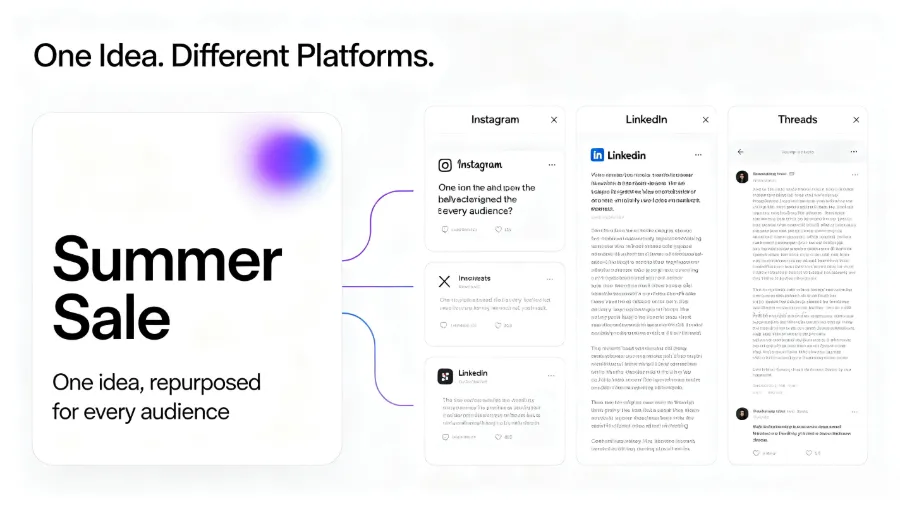
A creator’s case illustrates the point well: one creation, adapted and distributed to ten major social platforms, doubled the revenue. The core is not the content’s brilliance but the distribution efficiency that supports higher posting frequency, which in turn boosts account authority. Platform algorithms favor accounts that update consistently—a common trait across all social platforms.
Distribution efficiency directly affects two things: how high a posting frequency you can maintain, and how many cycles you can reuse your material. The limit of manual copy‑pasting is two to three posts per day, often with errors and omissions. The logic of semi‑automatic tool distribution is to write one piece, adapt it into ten, and publish it in ten places, extending the material’s lifecycle by several times. For a practical breakdown of cross‑platform distribution architecture, there is a thorough analysis on Medium worth further reading.
| Dimension | Manual Copy‑Paste | Semi‑Automatic Tool Distribution |
|---|---|---|
| Platform adaptation & rewriting | Manual adjustment per platform | AI automatic rewriting |
| Scheduled publishing | Must watch the clock | Smart timed batch scheduling |
| Multi‑account management | Switch login one by one | Unified dashboard management |
| Labor input | Several hours of repetitive work daily | One operation completes all platforms |
| Sustainable publishing frequency | Two to three daily posts is the limit | Stable support for high‑frequency updates |
A real case of a piece of content distributed to ten platforms breaks down the specific workflow and revenue changes, allowing small sellers to directly build their own distribution pipeline.
Small Sellers’ Publishing Rhythm: From Manual Copy‑Paste to Semi‑Automation
In daily actions, small sellers don’t need a complex system but a simple, workable flow: write one → AI adapt to each platform → preview → schedule → one‑click distribution. First get the process running smoothly, then consider scaling; piling up tools from the start only adds maintenance burden.
My own workflow is like this: first determine the 3–5 core selling points to promote this week, write a basic copy for each, then use a tool to rewrite them for each platform, preview to ensure no formatting issues, and schedule them uniformly. The whole process has been compressed from two hours daily to half a day weekly. Account integration takes about two minutes; the free plan provides three social accounts and six posts, and can be started without linking a credit card.
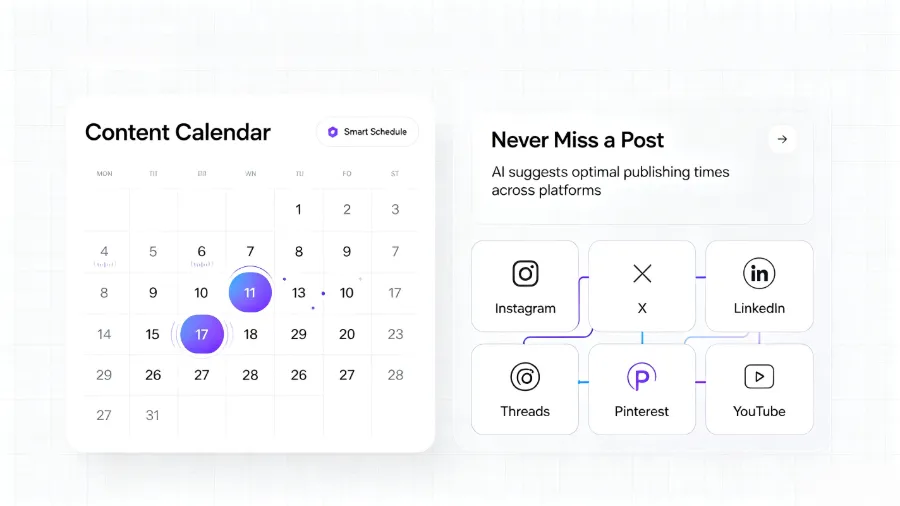
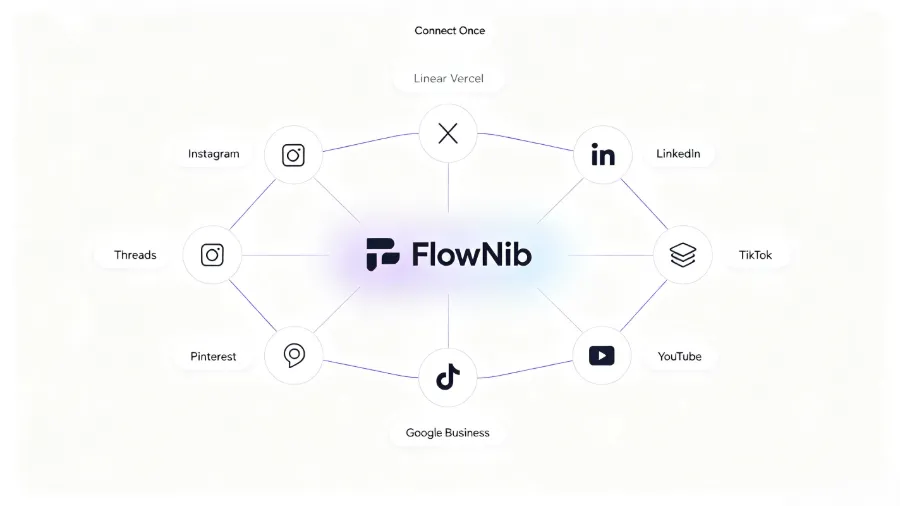
The importance of unified multi‑account management for team collaboration is underestimated by many. Operations, customer service, and advertising each manage a platform account, leading to unsynchronized information and frequent duplicate or missed posts. Consolidating into a single dashboard makes it instantly clear who posted what, when, and the results. Tools like Flownib offer two‑minute integration and direct official API connections, making publishing stability far more reliable than third‑party plugins. Once the automated workflow fills the social‑media publishing gap, the overall content operation rhythm truly takes shape.
Official API integration is the foundation for stable distribution; Meta’s official developer documentation details interface limits and call rates, which is worth reviewing before integration.
I have to pour a cold splash of reality here. I saw a small seller who, swayed by the “it’s too late” narrative, entered the market but was reluctant to invest in tools and process upgrades, relying on manual copy‑pasting across multiple platforms. Two to three daily posts exhausted their energy; many pieces of material were discarded after a single push. After two to three months, due to insufficient posting frequency and inability to build account authority, they quit hastily. They didn’t lose because the profit ran out, but because they didn’t adopt the correct operational approach.
FAQ
Is it still timely to join TikTok Shop in 2026?
Yes, but the approach has changed. The profit from indiscriminate stocking has indeed ended, but there is still space for long‑tail products and vertical content. The criterion is not platform size but whether you can maintain a stable content output frequency.
Approximately how much startup capital does a small seller need to prepare?
A deposit plus initial inventory plus a basic advertising budget—several ten‑thousands of yuan—can get you started. The real big factor is time cost—content creation and daily publishing maintenance will consume over 60% of your effort; this hidden expense is the key to surviving the cold‑start phase.
Why is content distribution more critical than opening a store?
Opening a store only gives you a shelf; traffic comes from content distribution. The same material distributed to ten platforms has near‑zero marginal cost, but exposure is several times that of a single platform. Posting frequency directly relates to account authority, which in turn determines organic traffic.
How big is the gap between manual publishing and using tools for automated distribution?
The limit of manual copy‑pasting is two to three daily posts, and it’s prone to errors and omissions. Semi‑automatic distribution can write one piece, adapt it into ten, and publish in ten places, doubling posting frequency and greatly increasing material reuse. The gap is not just about single‑time efficiency but about sustainable long‑term execution.
If a new store has no traffic, should you focus on content first or advertising first?
First get the content distribution process working, then talk about advertising. Without a stable content supply, traffic generated by ads cannot be sustained, and conversion rates will be poor. Once the publishing rhythm is stable and account authority builds up, advertising ROI will normalize.
Share Article