
How to Build a Content Matrix: The Correct Logic of One Main Hub + Multiple Distribution Points

Many cross‑border teams hit a snag right at the first step of building a content matrix—making each social media account produce its own content independently. The Instagram team writes Instagram posts, the LinkedIn team writes LinkedIn posts, the TikTok team shoots TikTok videos. The result? The team burns out, traffic gets scattered, and the brand voice gets diluted. A truly successful content matrix has a very simple structure: one main account handles deep content creation, while multiple distribution accounts adapt and spread the core message across different platforms. The main hub is the pond, the distribution points are the fishing rods—both are essential. This article breaks down that coordination logic and shows how tools can make the process run smoothly.
Why “Main Account + Distribution Points” Is the Correct Structure for a Content Matrix
The “each fights its own battle” model sounds reasonable—each platform has its own audience and language habits, so it needs an independent content team. But anyone who has run it knows that it multiplies labor costs and leads to inconsistent content quality. Managing five accounts, each producing three pieces of content per week, means 15 completely different pieces. The more content you have, the more the brand tone fragments.
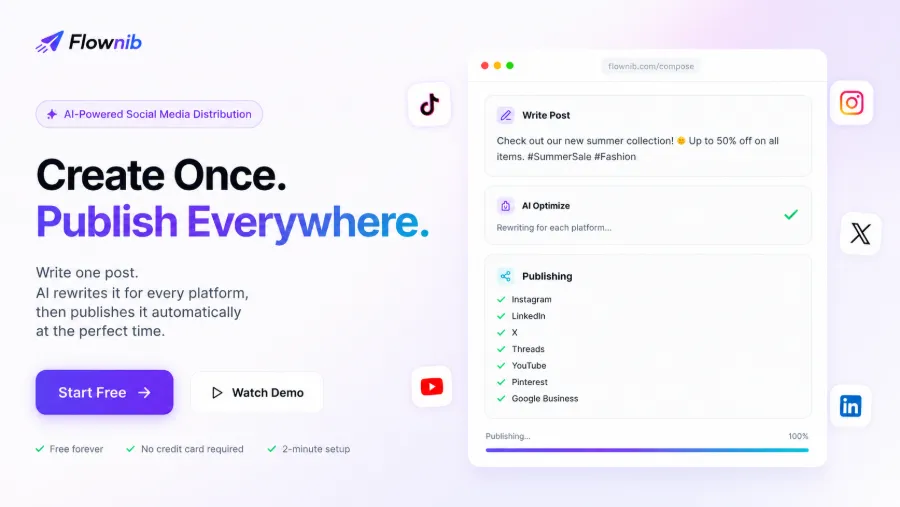
The “centralized distribution” model is completely different. The main hub—usually the brand website, a standalone site, or a core social media account—takes on the deep content production task. An industry insight, a product tutorial, a brand story—all debut there. The distribution accounts have only one job: reformat the hub’s content for each platform and then push it to Instagram, X, LinkedIn, TikTok, Threads, YouTube, Pinterest, Google Business, etc.
This structure is especially important for cross‑border sellers. Time‑zone differences make it impossible to manually post at each platform’s peak time; language differences require localization for every piece; platform rule differences mean the same content can be throttled or flagged on some channels. Manual copy‑pasting is simply not feasible.
A real‑world case: a social media agency used this structure to manage the voices of 50 client brands. The main account handled deep brand content, while distribution accounts adapted and amplified it across platforms, boosting team efficiency by nearly threefold. See the article “How Social Media Agencies Manage 50 Client Brand Voices” for details.
Content Strategy for the Main Account: What, How, and Who Maintains It
The main account is the brand’s content asset library and the engine of the entire matrix. Its content types should be deep: industry insights, product tutorials, brand stories, customer case studies. These pieces don’t chase trends or need daily updates, but each must be information‑rich and unique.
A typical production flow: topic‑selection meeting → draft → internal review (brand tone, data accuracy) → publish on the main hub. A rhythm of 2–3 deep pieces per week is reasonable—too few and distribution accounts have nothing to share; too many and the team gets overwhelmed.
The main account also has an often‑overlooked value: SEO. Each piece on the hub has a permanent original URL; when distribution accounts share it, they include that link, generating backlinks that boost the hub’s search authority. Distribution points can change, but the hub is the brand’s irreplaceable digital asset.
However, the main account can become a “self‑indulgent” account. The solution is data‑driven content adjustment—track which pieces get high click‑through rates, genuine comment discussions, or cross‑platform shares. If a piece gets zero interaction on distribution accounts, the topic likely needs rethinking.
Coordination Logic for Distribution Accounts: Adapt, Customize, Redirect
The core task of distribution accounts isn’t creation but adaptation. A deep article about a product launch can become a carousel of three images with a short caption on Instagram, five threads on X, and a full‑length industry observation with personal insights on LinkedIn. The core message stays the same, but the format and language style are fully tailored to each platform’s audience.
Adaptation rules include: character limits (X’s 280 characters vs. LinkedIn’s long‑form), image dimensions (Instagram’s 1:1 vs. Pinterest’s 2:3), posting times (see the Later blog for best times per platform), audience preferences (Instagram is visual, LinkedIn is professional).
The redirect mechanism is the part most distribution accounts overlook. Their comment sections should actively guide users back to the main hub—“Full version in the link,” “More cases on the website,” “Click the profile for the detailed tutorial.” Without redirects, distribution accounts become traffic black holes—followers grow, engagement rises, but the website sees zero traffic.
Suggested posting frequency for distribution accounts: 1–3 pieces per day to stay active. But beware: content must not be copied verbatim, or platforms will flag it as spam. AI rewriting is crucial here—maintaining brand consistency while making each piece feel native to its platform.
From Manual to Automated: How Tools Make This Logic Work
The pain points of manual execution are obvious: copy‑pasting is time‑consuming, error‑prone, and can’t guarantee consistency. Operators juggle 5–6 platforms daily, manually adjusting format and schedule for each piece. A team can spend over 10 hours per week on “搬运” (content搬).
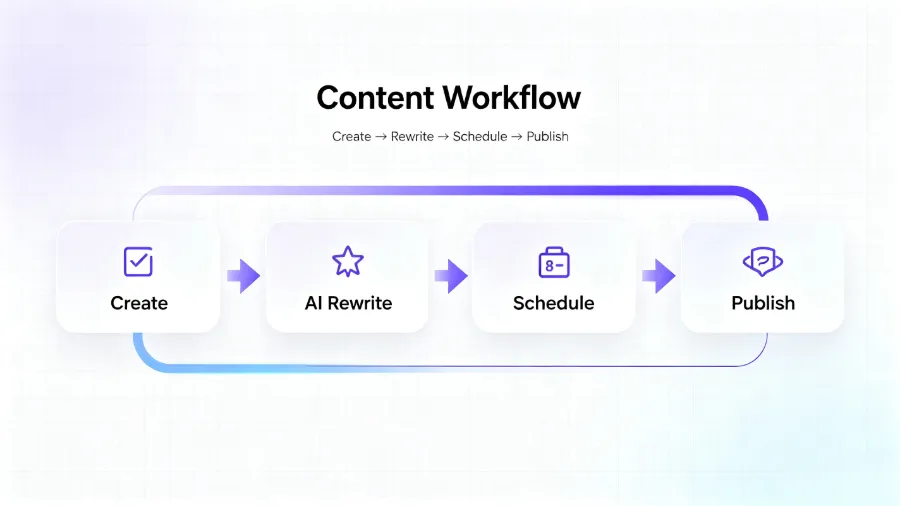
Automation tools need core capabilities: AI rewriting (automatically adapting main‑account content for each platform), one‑click distribution (publishing to all linked accounts simultaneously), scheduled publishing (auto‑scheduling based on each platform’s peak times), and a content calendar (visualizing the publishing plan for all accounts).
A typical workflow: write a deep piece on the main account → use Flownib’s AI rewriting feature to generate platform‑specific versions → preview and confirm → one‑click publish to all distribution accounts. The entire process from writing to publishing takes about 2 minutes for account connections and setup; subsequent posts take only seconds.
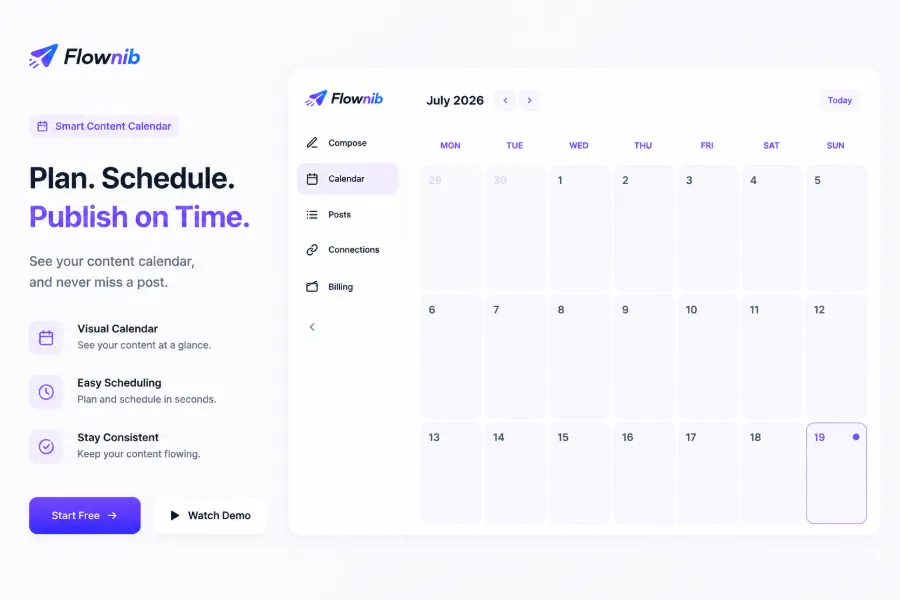
Flownib’s content calendar visualizes all accounts’ publishing plans, letting you instantly see what each account is posting this week and which ones are lagging. For teams managing multiple client brands, this feature directly solves the “content planning chaos” problem. For more details on automated distribution, see the article “Buffer Alternatives Deep Dive: Why You Need AI Distribution in 2026.”
For enterprise account operations, X for Business also offers guidance on account strategy and posting cadence, which can be used as a reference.
Common Mistakes and How to Avoid Them
Mistake 1: Distribution content mirrors the main account exactly. This is the easiest way to be flagged as duplicate content. The same link and caption appearing identically on five platforms will be treated as spam and penalized. AI rewriting isn’t optional—it’s essential.
Mistake 2: Distribute without redirecting. One team ran eight distribution accounts, gaining 30,000 followers in six months, but website traffic remained zero. The reason? No calls to action sending users back to the main hub. The distribution accounts became “traffic black holes,” and the brand’s effort didn’t accumulate any assets. The team eventually dissolved because ROI couldn’t be proved. See “Content Closed Loop Is the New Standard: A Look at Seonib, Veonib, and FlowNib” for a deeper case study.
Mistake 3: Main account updates too infrequently. Distribution accounts are amplifiers, not content sources. If the main account publishes only one piece per week, distribution accounts quickly run out of material. The main account’s update frequency sets the ceiling for the entire matrix.
Mistake 4: Ignoring platform algorithm differences. Instagram’s algorithm favors visual content; LinkedIn’s favors professional discussion. The same piece may get zero exposure on Instagram but go viral on LinkedIn. Distribution accounts must adapt to each platform’s algorithmic preferences. For a deeper analysis of cross‑platform collaboration architecture, see “Cross‑Border AI Full‑Traffic Closed Loop: FlowNib, Seonib, Veonib Collaboration Architecture and Use Cases.”
To evaluate whether the main and distribution accounts are working together effectively, look at three metrics: click‑through rate (link clicks from distribution accounts), redirect rate (percentage of traffic returning to the main hub), and follower growth (whether distribution accounts’ followers are steadily increasing). If click‑through is low but follower growth is high, the content is attractive but the redirect mechanism is lacking.
FAQ
Q1: How should the content ratio between the main account and distribution accounts be allocated?
The main account should produce 2–3 deep pieces per week, while distribution accounts post 1–3 adapted pieces daily. The ratio is roughly 1:7—one main‑account piece becomes seven platform‑specific distribution pieces.
Q2: Do distribution accounts need to create completely original content?
They don’t need to be completely original, but they can’t be direct copies. The core message stays the same, while language style, format, and publishing specifics are adjusted per platform. AI rewriting solves this efficiently; manual rewriting is too slow.
Q3: If there’s only one team, how can we maintain both the main account and multiple distribution accounts?
Use automation tools to reduce manual work. The team creates the main‑account content; the tools handle rewriting and publishing for distribution accounts. The team only needs to verify the AI‑generated content’s accuracy, not publish each piece manually.
Q4: Will followers of distribution accounts get annoyed by repetitive content and unfollow?
If every piece is identical, yes. But if each piece is adapted to the platform—Instagram uses images, X uses short posts, LinkedIn uses long‑form—the followers won’t feel repetition; they’ll think the brand “gets” each platform’s style.
Q5: Should the posting times of the main account and distribution accounts be staggered?
Yes, stagger them. After the main account publishes, let distribution accounts start sharing 2–4 hours later rather than simultaneously. This creates a time gap across platforms and prevents algorithms from flagging the content as “bulk posting.”
Share Article