
How to Choose AI Social Media Tools in 2026: Feature Overview and Practical Guide for Cross‑Border E‑Commerce

In 2026, cross‑border sellers no longer ask “Should we use AI tools?” but rather “There are so many tools, how do we choose without falling into traps.” There are at least dozens of social media management platforms on the market, each claiming to be “end‑to‑end” and “intelligent,” yet the real differences in daily operations are often far greater than the marketing copy suggests.
Differences in content formats across platforms, the challenge of publishing across time zones, and chaotic multi‑account management—these three issues are almost universal pain points for every cross‑border team. The selection criteria are actually simple: it’s not about having the most features, but about whether the tool can truly integrate into existing workflows and reduce long‑term maintenance costs. If a tool forces a team to spend an extra two hours per week on upkeep, most of its automation value is nullified.
First, the conclusion: when choosing an AI social media tool in 2026, focus on three things—breadth of multi‑platform coverage, stability of official API integration, and multi‑account management capability. All the flashy features can be deferred.
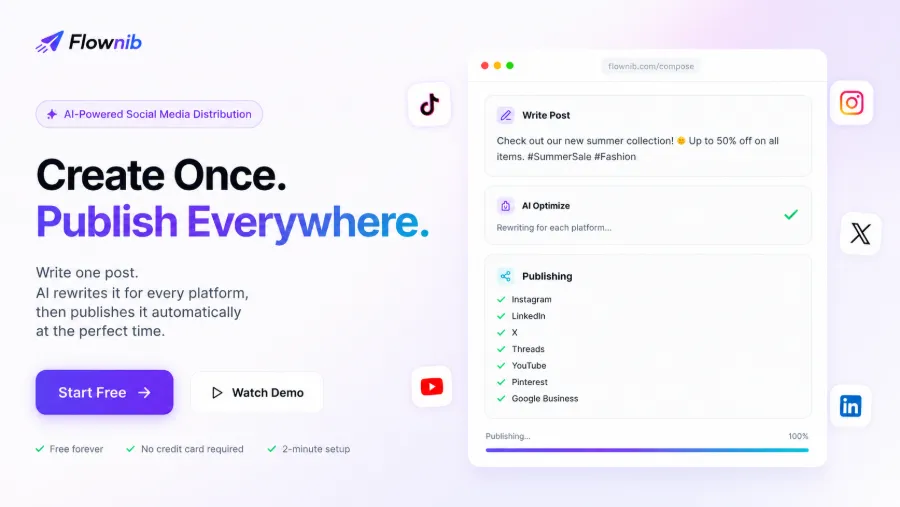
Capability Landscape of AI Social Media Tools in 2026
In recent years, AI social media tools have undergone a clear evolution: from a single “scheduler” to a full‑stack platform that covers content generation, cross‑platform distribution, and data feedback. By 2026, this trend has solidified, and the competitive focus among tools has shifted from “can it post?” to “how well does it post and how efficiently can it be managed?”
For cross‑border sellers, the most important dimensions fall into three categories. First, breadth of multi‑platform coverage—if the target market is Europe or the U.S., you can’t ignore Instagram, TikTok, and YouTube; B2B requires LinkedIn. Second, official API stability, which directly determines publishing success rates and affects account security. Third, multi‑account management capability; an operator handling five or six platform accounts would suffer noticeable efficiency loss if each platform requires separate login and switching.
Moving from manual copy‑pasting to fully automated distribution yields an average efficiency gain of about 15 hours per week—this figure recurs across multiple team feedback. The saved time doesn’t disappear; it’s reallocated to content strategy and comment engagement.
The positioning differences among mainstream tools are also worth outlining. Traditional SaaS tools like the Loomly social media management platform excel at content calendars and team collaboration workflows; Buffer and Hootsuite have deeper experience in scheduling stability and enterprise features; the new generation of AI‑native tools focus on content adaptation and automation depth.
| Tool | Core Positioning | Platform Support | Official API Integration | Ideal Use Cases |
|---|---|---|---|---|
| Flownib | AI‑native distribution | 10 major platforms | Full official API | Small teams quick start |
| Loomly | Content calendar & collaboration | 8 major platforms | Official API | Content team workflow management |
| Buffer | Stable scheduling | 6 major platforms | Official API | Lightweight timed publishing |
| Hootsuite | Enterprise management | Multiple platforms | Official API | Large team centralized control |
AI Content Generation and Intelligent Rewriting: Say Goodbye to Copy‑Paste
Each platform has its own temperament. Instagram is visual; a pure text post gets little traction. LinkedIn demands professionalism; a colloquial tone looks flippant. X (Twitter) requires brevity; conveying the message within 140 characters is the norm. The same product selling point can be presented as three completely different pieces of content across these platforms.
AI rewriting addresses this “translation loss” problem. Take a portable coffee machine as an example: on Instagram you might highlight the visual impact of “30‑second cup” with a latte art close‑up; on LinkedIn you’d emphasize the “office efficiency boost” scenario; on X you just need “30 seconds, a good coffee” plus the product link. The core message stays the same, but the expression is fully adapted to each platform’s context.
One often‑overlooked point: AI rewriting is not just swapping words; it adjusts the content structure based on platform characteristics. Character limits, hashtag density, emoji usage—these details affect the naturalness of the content. Supporting the ten major platforms and using official APIs for adaptation and publishing means each platform’s content can appear “native” rather than obviously mass‑posted.
Brand voice consistency is another key issue. If AI rewriting only pursues “platform‑like content,” the brand personality can be diluted. The solution is to front‑load brand information—product positioning, target audience, brand tone—so that the AI has a reference when rewriting.

Trend mining is also an important supplement to this stage. Instead of exhausting yourself daily to brainstorm topics, you can capture rising discussions on Reddit, Hacker News, etc., and then generate content from a brand perspective. Enter a keyword, the system scans growing discussions, and transforms high‑traffic topics into publishable posts—this workflow acts as a topic‑planning assistant for content teams. If content demand is high, you can also refer to the AI method for bulk generating a week’s worth of social media content to scale a single piece of creation into batch production.
Scheduled Publishing and Content Calendar: A Must‑Have for Cross‑Time‑Zone Operations
Domestic teams managing overseas accounts cannot avoid time‑zone differences. 10 a.m. Eastern Time corresponds to 10 p.m. Beijing time—asking operators to stay at their computers for manual publishing at that hour is neither realistic nor sustainable. The value of smart scheduling lies here: it automatically selects the optimal posting time based on audience activity, allowing posts to naturally appear during traffic peaks in the target market.
The actual workflow is simple. After connecting accounts, create a piece of content; AI recommends a publishing time based on platform characteristics and audience data, and after confirmation it goes into the content calendar. All subsequent platform releases are executed automatically by the system, requiring no manual monitoring. For multi‑account operations, the calendar’s value becomes even clearer—all platform schedules are consolidated into a single view, making it easy to see at a glance whether weekly content coverage is balanced and if any platform is missing.
Connecting accounts and initial setup take about two minutes, after which you can start publishing—this speed dramatically reduces migration costs when a team switches tools. If you need to check the status after scheduling, you can always refer to how to view scheduled Instagram posts to confirm execution.
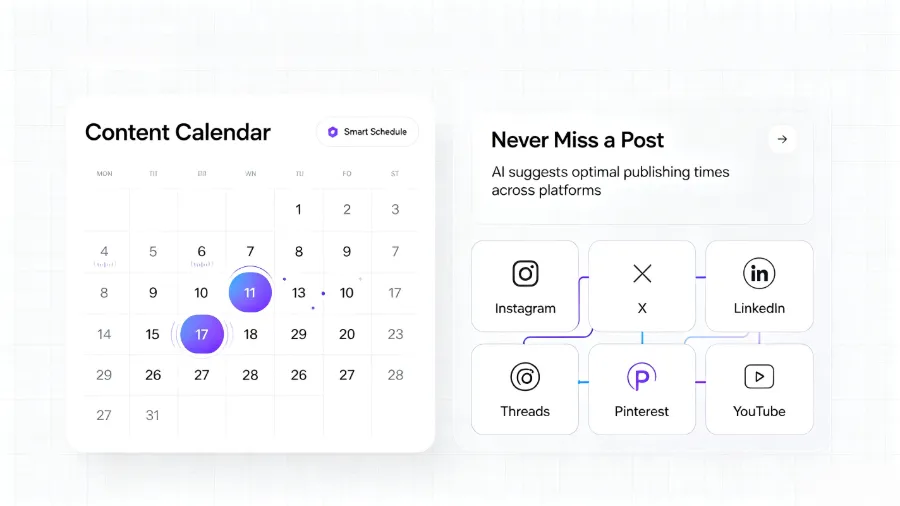
The content calendar also serves an often‑underestimated role: it turns “content planning” from a personal habit into a team process. Operators can schedule all platform content a week in advance on the calendar, and supervisors or clients can view the publishing plan at any time, reducing back‑and‑forth communication costs.
From Tools to Systems: How AI Distribution Integrates into Cross‑Border E‑Commerce Workflows
The difference between a single tool and a full AI workflow is evident only to those who have used both. A single tool solves the “publish” action, while a full workflow addresses the entire chain from content creation to multi‑channel reach. For cross‑border e‑commerce teams, the latter is the part that truly yields compound benefits.
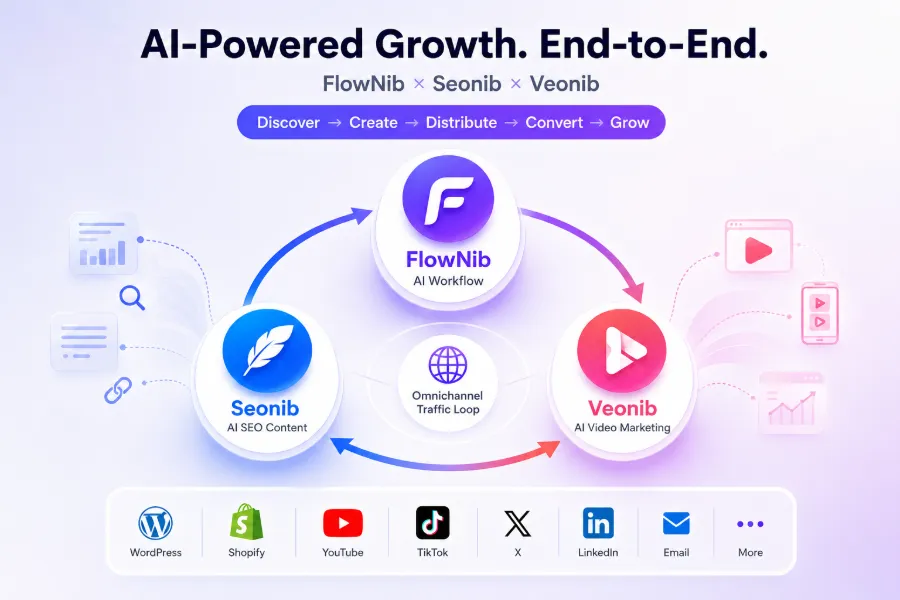
In the content production stage, AI agents (ChatGPT, Claude Code, Cursor, etc.) already handle draft writing and material organization; in the advertising stage, assets need rapid adaptation to the specifications and copy styles of different channels; the customer service system requires social media accounts to respond promptly to private messages and comments. If an AI distribution tool can act as a “connector” among these stages, its value goes far beyond saving a few hours of publishing time.
Small teams especially benefit from this lightweight tool matrix. Previously, covering five platforms required at least two to three people; now a single person with AI tools can achieve the same scale of content distribution. For emerging brands with limited budgets, the feasibility of this low‑cost matrix has been proven; a concrete roadmap can be found in the Low‑Cost Global Social Media Matrix Operations Guide.
The pitfalls encountered during selection are also worth mentioning. API stability is the first hurdle—some tools claim to support a platform but actually use unofficial interfaces, leading to frequent publishing failures and even triggering account risk controls. Data security cannot be ignored either; storing social media account credentials on an unreliable service poses significant risk. Expansion cost is another hidden factor; the free tier may work fine, but once the number of accounts and content volume increase, you need to assess whether the price increase of the paid tier is reasonable.
From the platform side, LinkedIn and others are strengthening their marketing tool ecosystems; the LinkedIn Marketing Solutions offer many enterprise features. However, native tools typically serve only their own channel, so unified cross‑platform management still requires third‑party tools.
A noteworthy trend: AI distribution tools are evolving toward “agentization.” By integrating social publishing capabilities into AI agents such as Codex, Claude Code, and Cursor via AI Skills, a single access token enables an AI assistant to directly manage social accounts, publish content, view history, and schedule posts. This pushes content operation automation one step further—AI can not only generate content but also execute the publishing action.
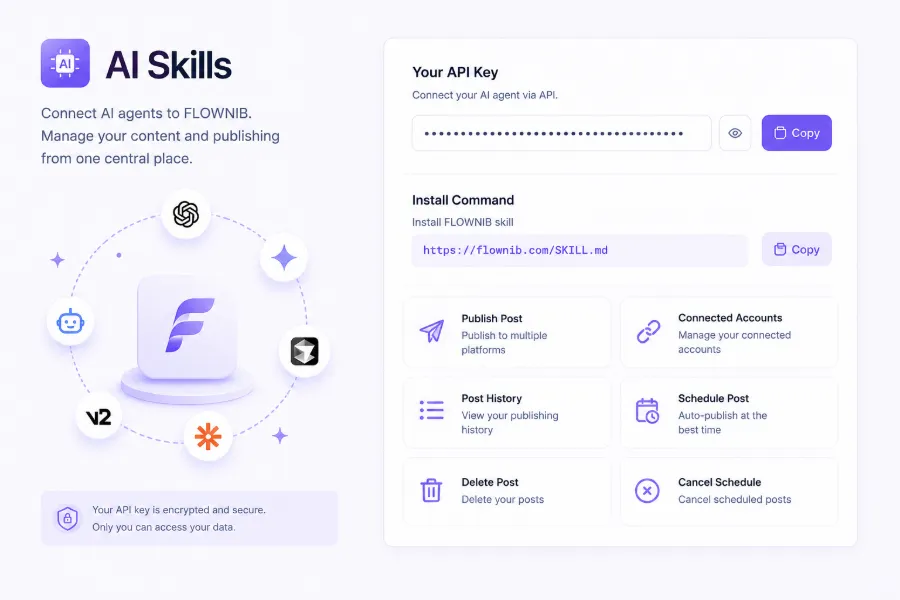
Two observations are worth sharing regarding tool selection. First, a tool’s true value lies not in “content generation” but in reducing the “translation loss” across platforms—brand voice consistency is the long‑term asset. Second, the free tier is the best way to test API stability and platform coverage; there’s no need to start with a paid plan. Use the free quota for two weeks of real publishing, monitor success rates and content performance, then decide whether to upgrade.
If a team already uses traditional tools like Buffer, before migrating they can read the in‑depth review of Buffer alternatives: the necessity of AI distribution to understand the real efficiency gap between AI distribution and traditional scheduling. For teams wanting a deeper dive into cross‑platform automation architecture, the Cross‑Platform AI Full‑Traffic Closed‑Loop Architecture Analysis offers a more systematic perspective.
Returning to the selection itself. In the 2026 AI social media tool market, functional gaps are narrowing; the real watershed is whether the tool can stably integrate into a team’s existing workflow rather than becoming another system to maintain. 99.99% API uptime and the ability to publish over 500 K posts—these numbers reflect the tool’s engineering capability, which is precisely the dimension most easily overlooked during selection yet most impactful on daily operations.
FAQ
Q1: In 2026, which three metrics should be prioritized when choosing an AI social media tool?
Breadth of multi‑platform coverage, stability of official API integration, and multi‑account management capability. These three metrics directly determine whether a tool can support the daily needs of cross‑border operations. It’s recommended to test the free tier for two weeks, monitor publishing success rates and content performance, then decide on a paid plan.
Q2: Do these tools help with multilingual account operations for cross‑border e‑commerce?
Yes, but it depends on the depth of multilingual support. The AI rewriting feature can generate content in different languages from the same product selling point, adapting to each platform’s linguistic conventions. In practice, it’s advisable to first test the rewriting quality for low‑volume languages before scaling up.
Q3: Where do the free and paid versions differ the most?
Mainly in the number of accounts, publishing quota, and depth of AI features. The free tier typically limits you to three social accounts and a small number of posts, suitable for testing stability; the paid tier unlocks unlimited accounts, higher publishing limits, and a fuller AI capability. If you have more than three accounts, the free tier is essentially insufficient.
Q4: Can AI rewriting cause content to lose brand personality?
It depends on whether brand information has been properly documented. If product positioning, target audience, and brand tone are pre‑loaded into the system, AI rewriting has a reference and can maintain brand consistency. Skipping this step and letting AI free‑form can indeed result in content that looks like a mishmash.
Share Article