
Who’s Posting for You at 3 AM? The “Plan + Forget” Scheduling Philosophy

In my third year of cross‑border e‑commerce, I did the math: to reach both East‑Coast US and European audiences, the optimal posting window falls roughly between 2 AM and 5 AM local time. That means setting an alarm at least three days a week to get up and post. After about a month, my sleep schedule was completely wrecked and my content became intermittent.
Then I realized one thing: the problem isn’t “what time to post,” but “who remembers to post.” The human brain shouldn’t be tasked with low‑value memory reminders like “publish on time.” Hand the scheduling over to a system and keep your attention on the content itself—that’s the sustainable approach.
This “schedule and forget” mindset sounds lazy, but in practice it actually steadies the content rhythm. This article explains the logic behind this scheduling philosophy and how it changed my daily posting cadence.
The 3 AM Trouble: Time‑Zone and Activity Curve Mismatch
Each platform has its own audience activity pattern. Instagram photos perform best during lunch and evenings, LinkedIn peaks on weekday mornings, and Threads discussions are concentrated at night. The dilemma for cross‑border sellers is that when your target audience is active, you’re probably asleep.
Take the US East Coast as an example: their lunch‑time phone scrolling corresponds to 1 AM–3 AM Beijing time, and their prime evening window falls between 5 AM–8 AM. In other words, to naturally maximize reach, cross‑border sellers almost have to post late at night. Manually setting alarms to get up and post works short‑term but inevitably collapses long‑term.
I’ve seen an independent‑site seller who, to hit the US East Coast prime time, manually posted at 3 AM for several weeks. Their sleep schedule fell apart, content frequency dropped from daily to weekly, and follower growth visibly slowed. This isn’t a matter of willpower; the manual process itself is unsustainable.
Worse, manual posting often relies on the impulse “I just thought of it,” causing the actual posting time to drift away from the peak window. One day you remember to post at 3 AM, the next day you’re busy and push it to 6 AM, the day after that you skip entirely. When the content rhythm breaks, the platform’s recommendation algorithm also cools off. Active‑time data for each platform constantly changes, but manually tracking those shifts is practically impossible.
Core of the Scheduling Philosophy: Plan, Then Completely Forget
I increasingly feel the biggest benefit of scheduling isn’t “being smarter,” but “being worry‑free.” It turns publishing from a task that requires willpower into something the system does automatically. You no longer agonize over “what to post today, and what time,” you just slot the content into a fixed schedule and turn off the backend to sleep.
The “forget” part is actually a conscious attention‑management strategy. The brain’s bandwidth is limited; by removing low‑value tasks like “remind myself to publish on time,” you free mental energy for the high‑value work of content creation and analysis. This aligns with the logic of Content Repurposing—create once, reuse across platforms, instead of brainstorming new ideas from scratch every day.
Compare two rhythms: one is “post whenever the idea pops up,” where frequency depends entirely on mood and busyness; the other is a fixed schedule, with all of next week’s content planned on Wednesday afternoon. The former is sporadic, the latter is consistent. Over the long run, accounts with a stable rhythm usually see follower growth outpace those with wildly fluctuating posting frequency, and platforms are more inclined to allocate traffic to consistently updating accounts.
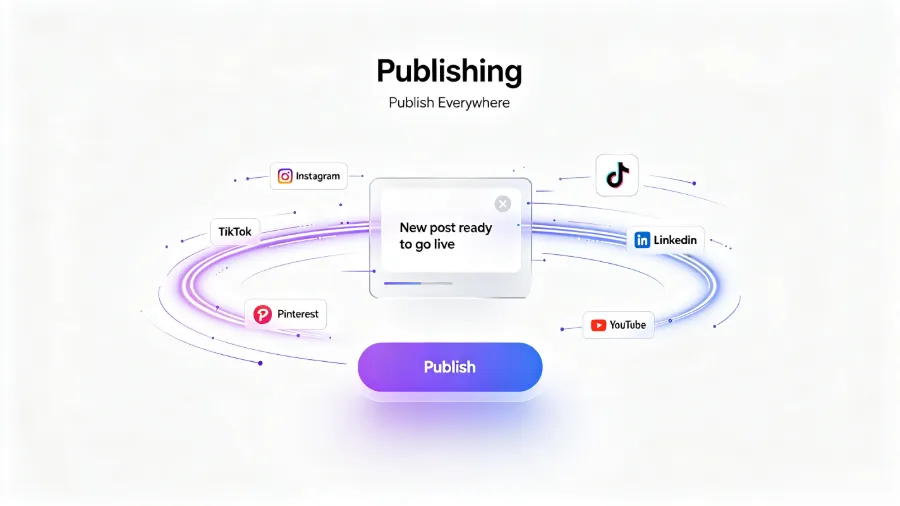
This isn’t high‑brow theory. The core of Social Scheduling is to separate “deciding what to post” from “actually publishing,” letting the system handle the latter. Multi‑channel Publishing works the same way—plan once, publish simultaneously across platforms, rather than operating each platform separately.
Turning Scheduling into a Habit: Content Calendar and Unified Workflow
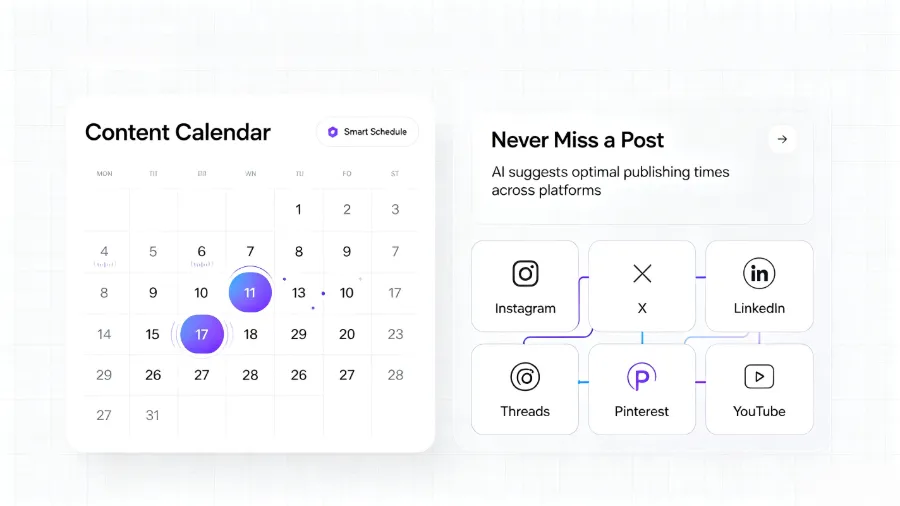
To truly implement scheduling, you need a visible table. The core value of a content calendar is aggregating scattered publishing plans from all platforms into a single visual layout, so you can instantly see what was posted this week, what’s missing next week, and which platform’s content density is low.
In practice, I usually schedule a week or even a month’s worth of content at once, then batch‑set it. Instead of spending 20 minutes each day pondering “what to post today,” I spend an entire afternoon each week slotting the next seven days’ content into the calendar, then completely shut down the backend. The efficiency gap is orders of magnitude.
There’s an unavoidable step: single creation, multi‑platform adaptation. Instagram demands visuals and short copy, LinkedIn requires a more formal tone, and Threads suits a light‑hearted discussion voice. Manually copying and pasting to each platform and tweaking each post is the hidden labor that consumes the most time in cross‑border operations. I later connected my accounts to Flownib, which rewrites the copy automatically according to each platform’s style and character limits, then schedules the unified release. Setting up and linking accounts takes about 2 minutes on average, saving half an hour to an hour each day of copy‑paste work.
This isn’t a complex engineering feat; each social platform already provides official APIs. The key is not to treat scheduling as an extra burden, but as a “handy” action—write the content, slot it in, and you’re done. The everyday practice of Omnichannel Marketing is essentially turning this process into muscle memory.
After Publishing: Forgetting Isn’t the End, Review Completes the Loop
“Forget” does not mean “abandon.” After a scheduled post goes live, you still need to regularly check each platform’s data to verify whether your initial assumptions about active times hold true. I set aside a fixed 30 minutes each week to review the previous schedule’s performance, identify which time slots performed better, and see which platform’s content types received more positive feedback, then fine‑tune the next plan accordingly.
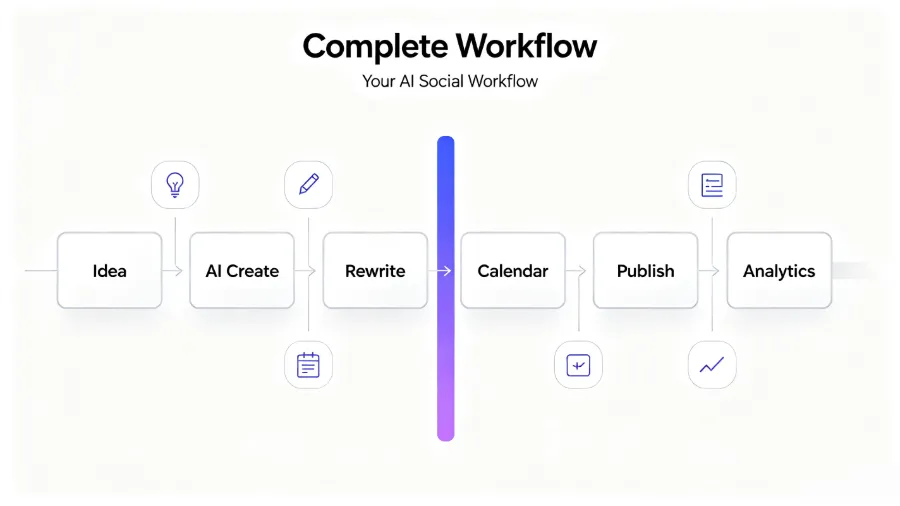
This iterative logic is simple: publish → view data → adjust → publish again. The scheduling tool handles execution; you only need to periodically check the results. Initially I was too lazy to spend those 30 minutes, but I soon realized that without review, scheduling becomes blind—posts go out, but you have no idea whether they’re effective.
During the review, focus on two things: platform data feedback, and whether the active‑time assumptions are valid. For example, I found LinkedIn’s weekday morning data significantly better than weekends, so I concentrate LinkedIn content from Monday to Friday; Instagram’s evening performance is stable, so I keep the evening schedule. Every link in Cross‑Platform Content needs data for calibration.
Content formats differ greatly across platforms—Threads’ short text and Instagram’s image‑plus‑copy require completely different handling. Scheduling tools can help you manage everything centrally, but the judgment about which format to adapt to still rests with a human.
The end goal of the entire workflow is a closed loop of content → publishing → review. Scheduling is just an intermediate step; it removes the publishing action from your to‑do list, freeing you to focus on what truly matters—clarifying the next piece of content and understanding why the previous one didn’t meet expectations.
FAQ
Is scheduled publishing really more effective than manual posting?
Not necessarily more effective, but more stable. Manual posting suffers from “post when I remember,” which often drifts away from peak windows; scheduled publishing guarantees output at a consistent rhythm, and platforms favor accounts that update continuously. The performance difference mainly comes from stability, not the scheduling itself.
Each platform has different optimal posting dates and times—can scheduling tools automatically choose them?
Some tools can recommend times based on historical data, but most still require you to set them. Start with each platform’s activity data for initial settings, then after two or three weeks fine‑tune based on actual results; this is more reliable than fully trusting tool recommendations.
Do I still need to log into each platform after scheduled publishing?
Yes, but not daily. Reserve a fixed 30 minutes each week to check data feedback and comment interactions across platforms. Scheduling handles publishing; interaction and review still need human involvement.
Which time zone should cross‑border sellers use for scheduling?
Use the active time zone of your target audience, not your own. If your main market is the US East Coast, schedule according to their lunch and evening windows. That’s the value of a scheduling tool—you don’t have to wake up at 3 AM; the system publishes for you.
How far in advance should a content calendar be planned?
One week to one month is fine; it depends on your content production capacity. Start with a weekly plan, then extend to two weeks or a month once the process runs smoothly. The longer the schedule, the more you need a steady content supply; otherwise the calendar will have empty slots.
Share Article