
How Brand Background Makes AI-Generated Content More Relevant to Cross‑Border E‑Commerce

Cross‑border e‑commerce teams often have to prepare different versions of the same product for the U.S., Germany, Japan, and Southeast Asian markets. The copy may have no grammatical errors on the surface, but once placed into the publishing calendar another layer of problems appears: it doesn’t clarify who the brand serves, nor does it address the real concerns of local buyers. AI can make sentences flow, but it doesn’t automatically know which selling points must be kept and which promotions have expired.
Brand background isn’t about giving AI more adjectives; it provides executable decision boundaries for generation, rewriting, and multi‑platform distribution. It should define brand positioning, product facts, target buyers, market context, and marketing goals, so the system knows what to emphasize, what to discard, and how to express itself at different purchase stages.
This is the most underestimated aspect of cross‑border content operations: relevance is not the same as linguistic fluency. Only content that simultaneously meets brand facts, target market expectations, and platform expression has a chance to be understood by buyers and drive the next action.
Brand Background Is Not a Synopsis; It Is the Decision Boundary for AI‑Generated Content
Brand introductions usually serve human readers, while brand background serves continuous judgment. The former can tell the founding story, vision, and values; the latter must answer more concrete questions: What problem does the product solve for whom? Are the target market’s buyers in the comparison, consideration, or repurchase stage? Does the brand rely on low price, durability, fast service, or professional after‑sales to build trust?
At a minimum, organize five categories of fields: brand positioning, product information, audience, market, and marketing goals. Product information should not just say “high quality” or “suitable for everyone”; it must record specifications, applicable scenarios, effects that cannot be promised, inventory limits, and currently valid pricing rules. Target buyers should go beyond “global consumers” and clarify usage frequency, purchase concerns, common questions, and decision makers.
Brand stories can help shape narrative, while generation rules restrict content selection, tone, and selling‑point ordering. For example, a home‑goods brand that emphasizes durability and after‑sales support should not automatically prioritize low price and fast purchase just because a market is trending “minimalist living.” Trending topics can provide direction, but they cannot replace brand judgment.

When the same product faces different countries, platforms, and purchase stages, generic prompts quickly become ineffective. Instagram may need visual scenes and short action verbs; LinkedIn is better suited for explaining industry background; TikTok demands a rapid entry into usage conflict; Google Business often revolves around store services or local actions. Without brand background, AI can only guess based on common writing patterns seen in training data, resulting in an “average e‑commerce copy” answer.
| Background Field | Information to Provide | Affects Content Judgment | Common Issues When Missing |
|---|---|---|---|
| Brand Positioning | Price tier, differentiation promise, service mode | Tone, selling‑point order, comparison scale | Copy is vague, brand indistinguishable from competitors |
| Target Buyer | Usage scenarios, concerns, purchase stage | Depth of explanation, case examples, action verbs | Only describes product, doesn’t answer buyer questions |
| Product Information | Specs, limits, valid selling points | Fact accuracy and promise boundaries | Overstated effects, mixing expired information |
| Market Context | Country, language, culture, platform habits | Local examples, expression order, visual focus | Translation flows, but purchase context is wrong |
Brand background must also be concise and structured. Stuffing dozens of pages of old campaign material into the generation pipeline does not automatically improve relevance; it may cause AI to cite expired discounts, obsolete models, or discontinued services. Content teams usually set update times and owners for each field to avoid mistaking “existing brand material” for “still‑valid brand material.”
From Brand Background to Relevant Content: Three Layers of Transformation
The first layer converts brand background into audience relevance. “Targeting global consumers” is not an audience description; it doesn’t tell the system why a buyer would stop to read. A more usable phrasing is: British renters worry about complex installation, Australian outdoor users care about weather resistance, Japanese consumers focus on storage size and after‑sales instructions. This gives AI the condition to link product selling points to audience pain points.
The second layer translates product selling points into platform and market adaptation. Product facts stay the same, but title length, content structure, action verbs, and visual emphasis can change. A “foldable” fact might become a before‑and‑after storage comparison on TikTok, a space‑layout scene on Pinterest, or a concise sentence solving a specific hassle on X.
The third layer separates brand consistency from market localization. Brand consistency handles core promises, prohibited language, and factual boundaries; market localization allows changes in language, examples, narrative order, and even question entry points. Treating consistency as “the same set of sentences for every market” reduces localization to mere translation.
After rewriting, human review must still handle factual, compliance, and cultural risk judgments. The system can recognize platform tone but cannot reliably assess a country’s sensitivity to health claims, eco‑friendly wording, or discount phrasing. Relevance is not about repeating brand material; it’s about answering a specific buyer question without crossing factual boundaries.
Cross‑border products can follow a fixed checklist:
- Generate a draft, first confirming theme and purchase stage.
- Verify brand facts, removing unverified effects and old promotions.
- Check market context, reviewing examples, units, cultural expressions, and audience concerns.
- Perform platform rewriting, then have humans confirm format, compliance, and action paths.
This means every piece of content must undergo three layers of checks: brand facts, market context, and platform expression. Merging these three checks into a single “looks fine” read‑through usually misses the hardest‑to‑spot errors, because factual mistakes and cultural mismatches often don’t affect sentence fluency.
When Publishing Across Platforms, Brand Background Reduces Rewriting Drift and Operational Rework
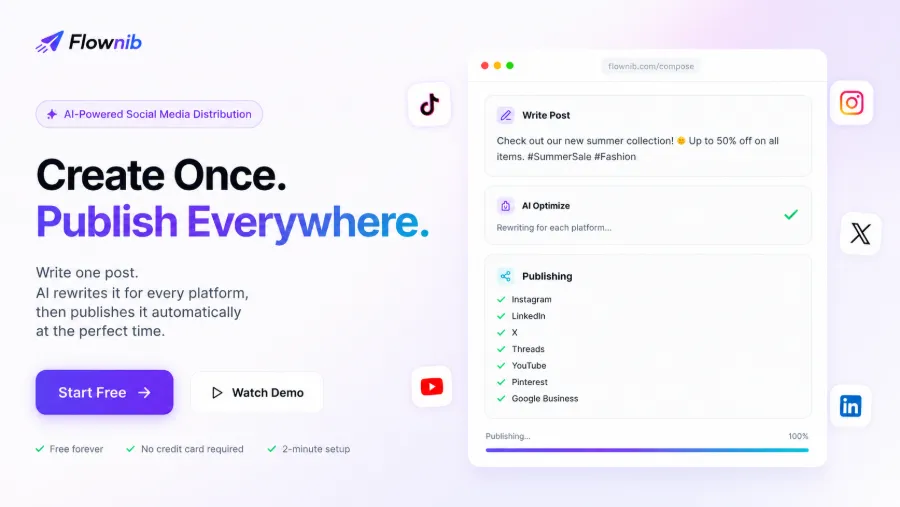
When cross‑border teams publish the same theme on Instagram, X, LinkedIn, TikTok, Facebook, Threads, Pinterest, YouTube, Bluesky, and Google Business, the issue is not a lack of copy but that versions gradually drift from the original brand intent. Some manually delete product limits; others add unapproved promises to fit platform tone. Eventually, ten versions look natural individually but no longer sound like the same brand.
In such workflows, Flownib is placed after the initial writing for adaptation: keep unified product facts and brand background, let AI rewrite according to platform style, then have operators preview each version and schedule publishing. It supports ten social platforms; the average setup time for a product page is two minutes, but that does not mean content review can be skipped after two minutes.
Cross‑platform adaptation can follow the Cross‑Platform Content Adaptation Steps. The goal is not to mechanically copy a paragraph ten times, but to lock immutable information first, then adjust length, opening style, and action paths. Brand background serves as a “gatekeeper”: it helps AI decide which selling points to discard, not just to unify brand tone.
A prudent workflow is: unify theme, lock immutable information, generate platform versions, conduct human review, then schedule publishing. If a team uses one‑click multi‑platform sync, an early judgment error can be amplified across all accounts; a single product spec mistake can affect every post.
Platform permissions and API behavior also affect whether content can be smoothly published. Instagram image ratios, TikTok video requirements, LinkedIn document formats, and Facebook page permissions can cause the same batch of content to yield different results. Specific permission changes should be verified via the Platform Developer Documentation. Official APIs reduce copy‑pasting and tab‑switching but cannot replace the team’s decision on whether a market should use a certain expression.
Product pages support ten platforms, but actual operations still need multi‑account management, publishing records, and preview steps. For a team managing multiple country sites, one less copy‑paste does not equal one less judgment; what truly reduces friction are fewer version omissions, wrong tabs, and mistimed scheduling.
After Establishing Brand Background, Use Feedback and Maintenance to Validate Relevance
Brand background is not a one‑time form. Product revisions, market expansions, seasonal promotions starting or ending all change AI’s judgment of selling points and audience. Publishing records are not just archives; they reveal where brand background has become outdated.
A real operational failure occurred a week after launch. The team built content templates for multiple markets, entered product information and brand tone, but failed to remove an old promotion field. A week later, when reviewing versions across markets, many pieces still used the expired promotion. The team had to rework each piece and delay publishing; the issue manifested not as a system crash but as a silent version‑maintenance error.
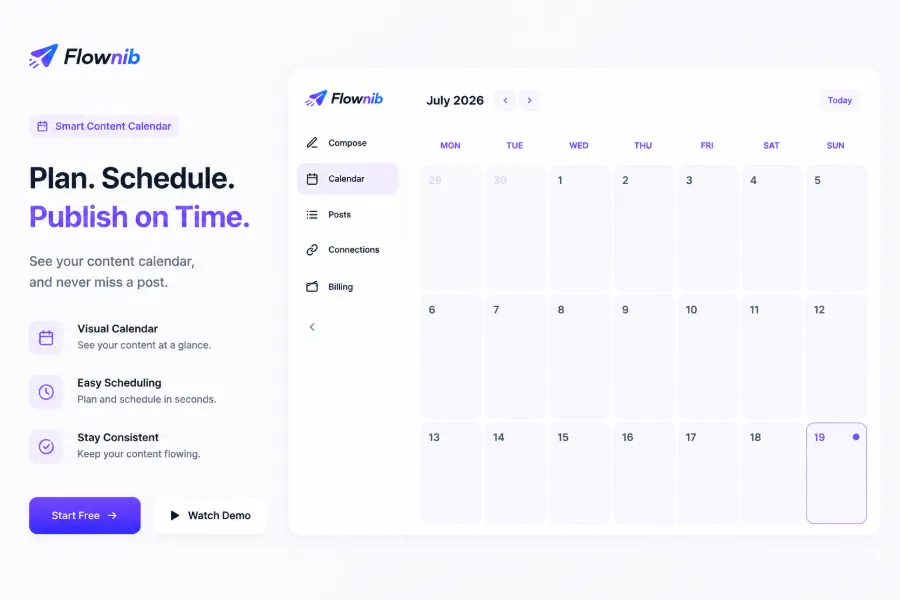
Therefore, content calendars, publishing records, and version management should be placed in the same review chain. When operators view the Social Media Schedule, they should not only confirm timing but also cross‑check current promotions, target markets, and product versions. If multiple markets show similar errors on the same day, the brand data is likely outdated; if only one platform has an issue, it’s more likely a platform‑specific rewrite or permission problem.
During planning and retrospectives, Flownib’s content logs help teams compare drafts, platform versions, and final published pieces. Cross‑border teams can also consult Social Content Operations Resources to check calendar design, review frequency, and account collaboration, rather than attributing all anomalies to AI generation quality.
A minimal maintenance rhythm could be a weekly review of brand background and a monthly comparison of human rework time versus error logs. Continuously monitor brand fact error rate, human rework time, market version retention rate, engagement quality, and publishing failure rate; these metrics need not be packaged into a single growth score because they answer different questions.
If background rules are too broad, generated results revert to “suitable for all consumers” or “enhance life quality” filler statements; if too narrow, localization becomes locked, making every market look like the same translation. Teams should retain core promises and prohibited boundaries while allowing local examples, narrative order, and opening questions to vary.
When reviewing cross‑border sellers’ brand consistency, the Cross‑Border Seller Tool Evaluation can serve as a workflow reference, but actual judgment should still return to version differences. Social media automation reduces operational steps but also lets outdated background spread faster—this is the hidden cost of scaled publishing.
Use a Reusable Checklist to Judge Whether Content Is Truly More Relevant
Before generation, check that the brand background contains current product facts, target market, and target buyer. If the product has changed packaging, price, or specifications, update the data first, then let AI generate content; otherwise, subsequent reviews only keep patching source errors.
After generation, verify that the content answers the audience’s real questions rather than merely mentioning the brand name. The copy should describe usage scenarios, address concerns, or suggest next steps, and confirm that selling‑point ordering matches the current purchase stage. “Sounds like the brand” can be an initial filter but not a relevance conclusion.
Before publishing, check platform format, local expression, and compliance risk. Teams should first select two representative markets and choose platforms with clear differences for a small‑scale validation. After observing three‑stage results, scale up. Generating dozens of market versions in one batch saves initial effort but can also copy the same error across all publishing records.
The final judgment criteria should satisfy four points simultaneously: content accuracy, buyer comprehension, alignment with local context, and service to a clear purchase or awareness stage. AI speeds up generation and rewriting; human review handles facts, culture, and compliance boundaries. The clearer the process between them, the more likely brand background will bring actual relevance rather than becoming an unmaintained document.
FAQ
Why does brand background affect the relevance of AI‑generated content?
Because brand background supplies AI with product facts, target buyers, and market context, enabling the system to decide which selling points to keep. Using only generic prompts can produce copy in minutes, but it may answer the wrong question or cite expired promotions.
Which background information should cross‑border e‑commerce brands prioritize?
Prioritize brand positioning, product information, target buyer, target market, and marketing goals—five categories. Whenever a product or promotion changes, update the background before the next content generation to avoid post‑publish factual errors.
Will brand consistency clash with localized expression?
No, as long as core promises and prohibited language are managed separately from expression style. Brand facts and forbidden promises stay unchanged; language, examples, and narrative order can be adjusted per market, with a final human cultural check before publishing.
How to tell if AI‑generated content merely mentions the brand versus truly serving the target audience?
Check whether the content answers a specific audience question and whether the selling‑point order matches the purchase stage. In practice, compare two representative market versions; a single review round usually reveals whether the copy is just a brand slogan or actually addresses local concerns.
How often should brand background be reviewed and updated?
At a minimum, conduct a weekly review and compare monthly rework time, factual error rate, and publishing failure records. When a product, market, or promotion changes, update the background immediately before the next generation cycle.
Share Article